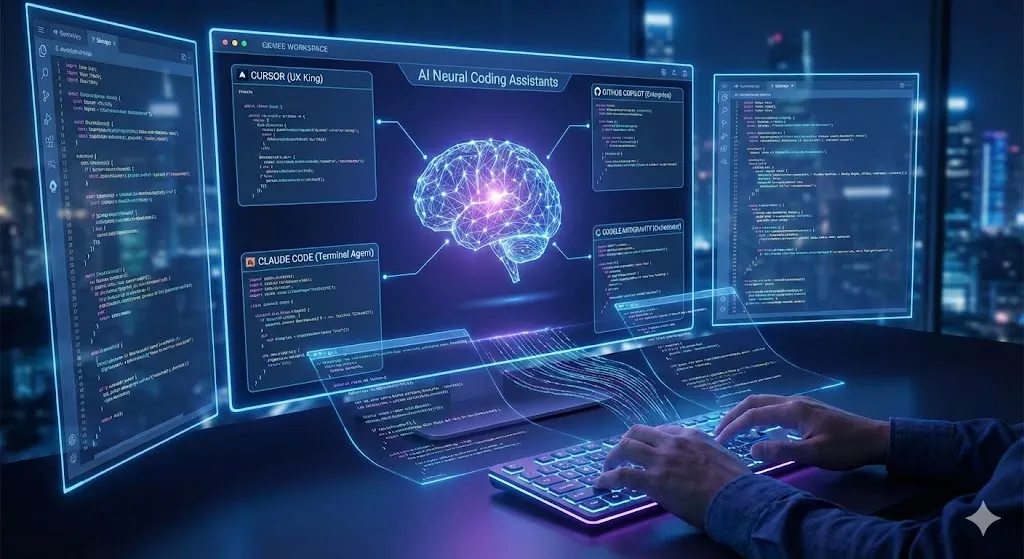
AI Engineering Masterclass
Build & deploy LLM applications in production.
From agentic RAG retrieval to distillation and guardrails.
A hands-on curriculum for software engneers and data scientists who want production stacks. Ship FastAPI services, tuning pipelines, and deployable source code you can put on GitHub.
BUILD · DEPLOY · SHIP
8 Portfolio-Ready LLM Apps You'll Build & Deploy
Each module ends with a runnable system: indexing/serving code, architecture diagrams, and cloud deploy paths. Start with launched modules—Custom GPT, CodeContext Engine, Digital Clone, Ad-Creative Agent, and Booking Assistant—then continue through System-2 reasoning, multi-modal RAG, and governance.





What You'll Master
This curriculum provides a deep dive into the essential techniques powering the end-to-end LLM lifecycle.
The Production-Grade Stacks throughout LLM Lifecycle
You will learn to navigate production-grade stacks, selecting the right tools and architectures tailored to your specific project needs.
By the end of the course, you will be able to implement these techniques and deploy LLM systems into production environments.
For Developers, Data Scientists, Builders
This course is designed for those who want to bridge the gap between AI Enthusiast and AI Engineer.
- Software Developers: Learn how to integrate LLMs into your existing tech stack without the fluff.
- Data Scientists: Move from static notebooks to functional, agentic applications.
- Self-Taught Builders: Get the diagrams and source code you need to turn your ideas into a portfolio-ready MVP.
CURRICULUM · 8 PARTS
The Full Curriculum
From LLM Foundations to Multi-Modal Agents
MODULE 01 / 08
LIVEThe LLM Backbone: Building a RAG-Based Custom GPT from Scratch
Go under the hood of modern LLMs—curate Common Crawl WARC data, train a custom BPE tokenizer, control generation with logits bias / temperature / repetition penalty, and ship a RAG web-summarizer Custom GPT with interactive decoding (greedy, beam, top-k, top-p).
From-scratch RAG backbone: WARC curation → BPE tokenization → logits control → decoding strategies → FastAPI microservice.
YOU'LL BUILD
Web Summarizer Custom GPT
- T01Perform Common Crawl & heuristic filtering on raw WARC web data.
- T02Build a BPE tokenizer to map text to tokens with a custom vocabulary.
- T03Adjust logits via logits bias, temperature, and repetition penalty.
- T04Interactively apply stochastic and deterministic decoding methods (greedy, beam, top-k, top-p).
- T05Deploy the inference via an API as a production-ready microservice.
MODULE 02 / 08
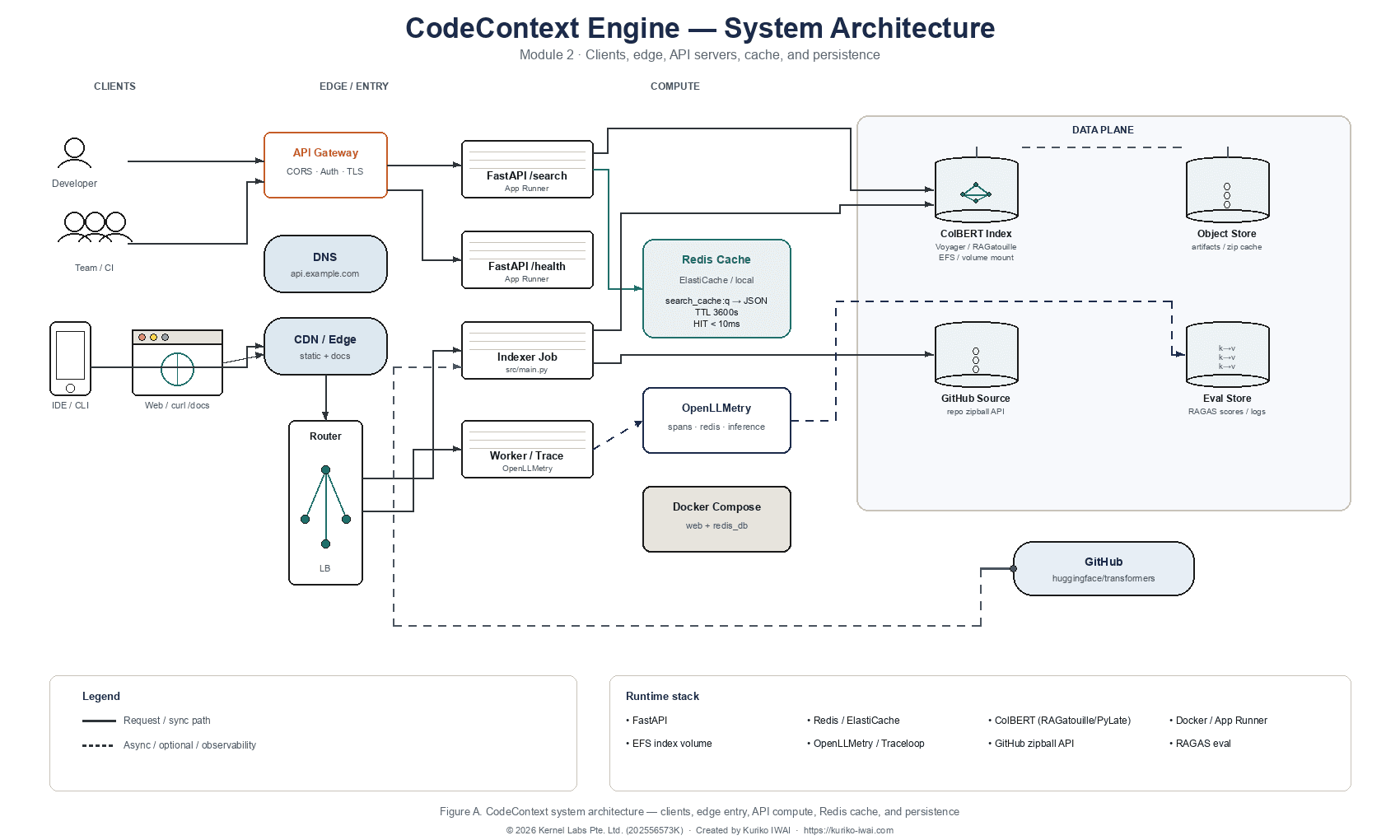
LIVECodeContext: Low-Latency Neural Code Search Engine
Ship a production-grade neural code search stack—ColBERT late interaction for token-level MaxSim matching, AST/Tree-sitter chunking across languages, Redis semantic cache for sub-10ms hits, plus RAGAS evaluation and OpenLLMetry traces behind FastAPI.
Advanced neural retrieval optimizing the tradeoff between ColBERT interaction depth and system throughput with Redis + FastAPI.
YOU'LL BUILD
Neural Code Intelligence Engine
- T01Custom AST Parsing for structural code chunking and function-level indexing.
- T02Late Interaction (ColBERT) for fine-grained, token-sensitive code search.
- T03Semantic Caching (Redis) to accelerate recurrent architectural queries.
- T04Evaluate performance with RAGAS and trace via OpenLLMetry to profile bottlenecks.
MODULE 03 / 08
LIVEDigital Clone: Persona Fine-Tuning & Edge Distillation
Engineer a high-fidelity interactive persona by distilling frontier-model linguistic patterns into a localized Llama-3.2-3B footprint—multi-stage SFT → RKD → DPO, QLoRA adapters, GGUF quantization, and vLLM/SageMaker streaming for edge and cloud.
High-fidelity digital clone: distill GPT-5.4 reasoning into Llama-3.2-3B via SFT–RKD–DPO, then deploy with vLLM and edge-ready GGUF quantization.
YOU'LL BUILD
Edge-Native Digital Clone (Smartphone/Web)
- T01Distill latent reasoning and Chain-of-Thought (CoT) capabilities from GPT-5.4 into a 3B model.
- T02Engineer multi-stage tuning pipeline - SFT for grounding, RKD for logic, and DPO for stylistic parity.
- T03Standardize input/output schemas using chat templates.
- T04Implement 4-bit quantization (GGUF) to balance VRAM efficiency and perplexity for edge hardware.
- T05Deploy via AWS SageMaker LMI/vLLM engine for paged-attention concurrency and real-time streaming.

MODULE 04 / 08
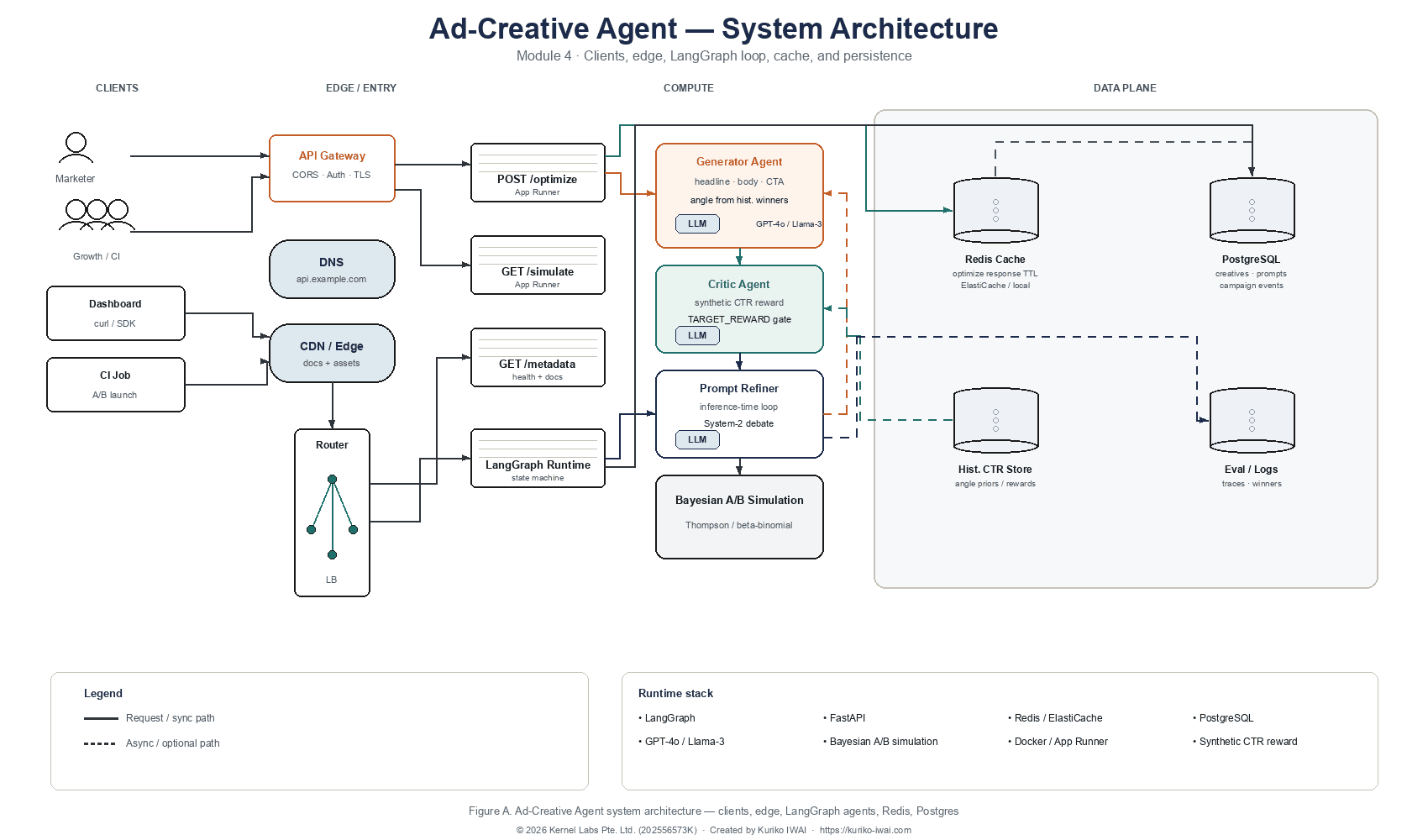
LIVEThe Revenue Engine: Self-Optimizing Ad-Creative Agent
Build an autonomous LangGraph system that generates, audits, and self-corrects ad creatives against synthetic CTR rewards—closed-loop Generator→Critic→Prompt Refiner, Bayesian A/B simulation, Redis cache, and FastAPI serving tied to revenue metrics.
Multi-agent LangGraph orchestration: closed-loop Generator ↔ Critic with persistent state, synthetic CTR rewards, and Bayesian A/B launch selection.
YOU'LL BUILD
A Self-Learning Digital Marketing Suite
- T01Multi-Agent Orchestration with LangGraph
- T02Closed-loop feedback for continuous model improvement
- T03Inference-time Scaling (System-2 Thinking)
- T04Synthetic Reward Signals for CTR Simulation
- T05Bayesian A/B Testing Simulator for prompt refinement
MODULE 05 / 08
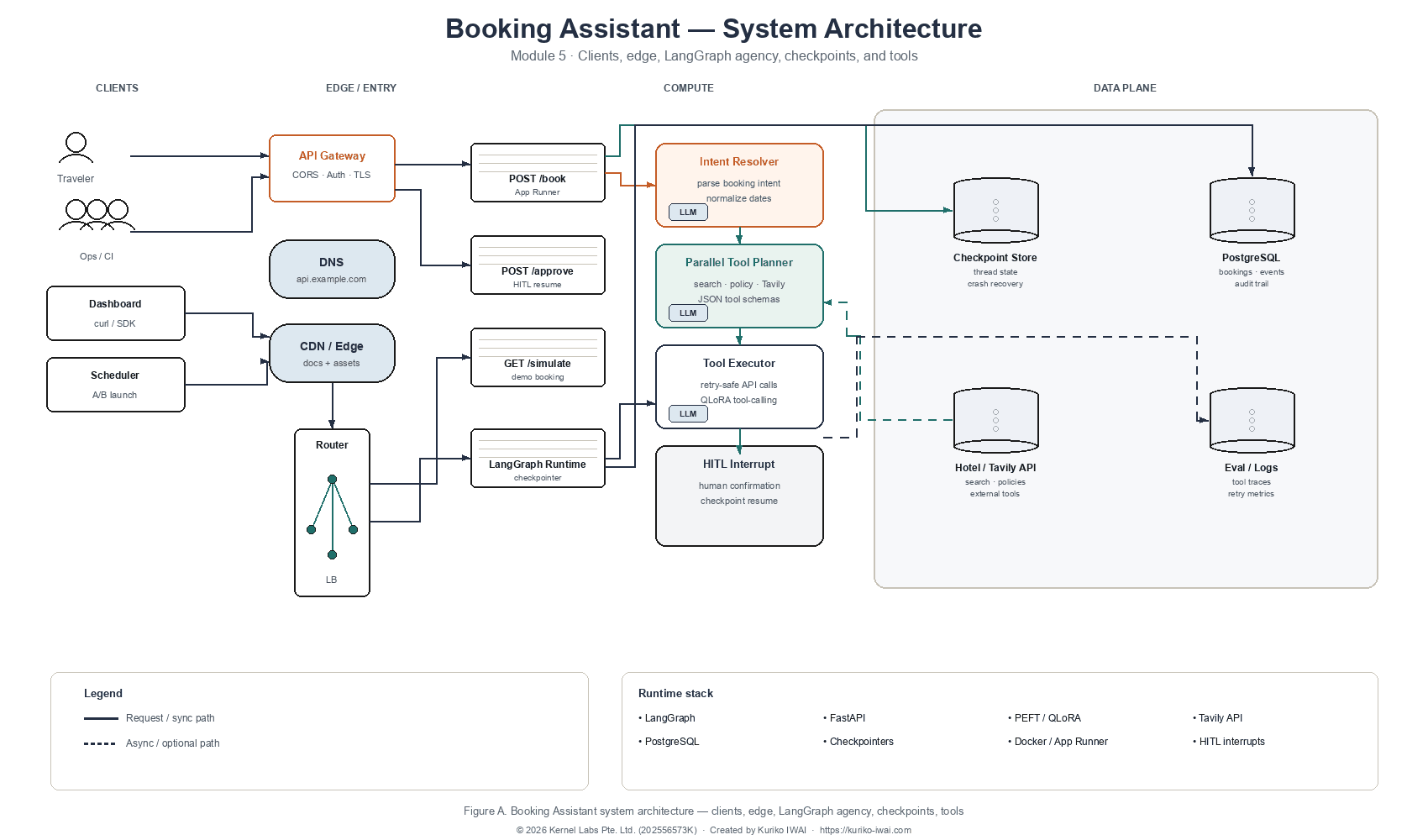
LIVEAutonomous Executive Agent: Fault-Tolerant Action Layer
Master the Action layer—build a fault-tolerant LangGraph agent that plans parallel tools, retries flaky APIs, interrupts for human approval, and resumes from crash-surviving checkpoints for high-stakes bookings and scheduling.
LangGraph state machines + checkpointers for long-running agency: QLoRA tool calling, parallel tools, HITL interrupts, and Postgres lineage.
YOU'LL BUILD
A Hotel Booking Assistant
- T01QLoRA fine-tuning for high-precision tool calling.
- T02Parallel tool execution for complex multi-step tasks.
- T03Adapter-based training for JSON reliability.
- T04Interrupt-driven workflows (Human-in-the-loop).
- T05Fault-tolerant retry logic for API failures.
MODULE 06 / 08
COMING SOONSystem-2 Thinking Assistant: Multi-Step Reasoning Engine
Build a high-fidelity reasoning partner that plans with Tree-of-Thoughts, stresses answers through adversarial debate, and self-critiques before acting—scaling inference-time compute where shallow sequential LLM output fails.
Agentic System-2 framework: Tree-of-Thoughts, adversarial reflection, and recursive planning to simulate deliberate non-linear cognition.
YOU'LL BUILD
Decision Reasoning & Planning Assistant
- T01Tree-of-Thoughts (ToT) for exploring multiple reasoning branches.
- T02Adversarial Multi-Agent Debate to reach consensus through conflict.
- T03Self-Critique & Reflection loops for iterative logic refinement.
- T04Sequential Planning-Execution-Verification (PEV) cycles.
- T05Inference-time compute scaling inspired by DeepSeek-R1 logic.

MODULE 07 / 08
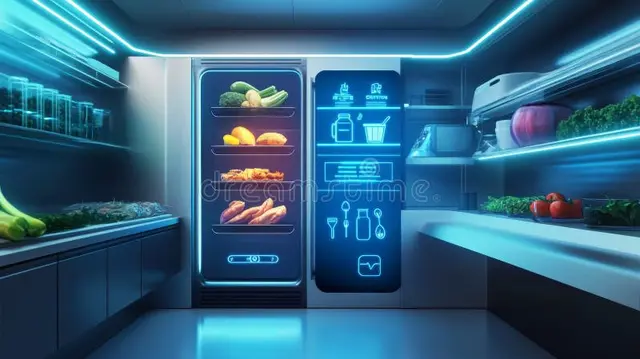
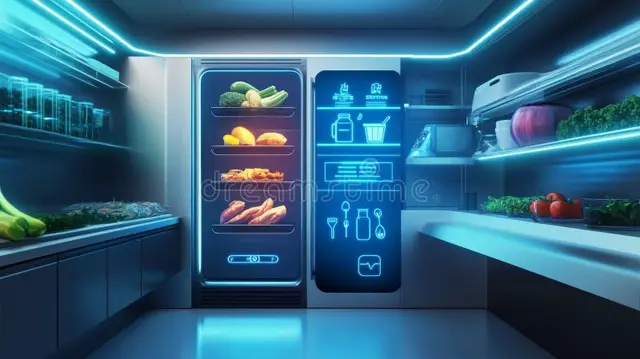
COMING SOONThe Smart Fridge: Visual Grounding & Multi-modal RAG
Build a nutritionist that sees—identify ingredients from photos with Vision-LoRA grounding, retrieve via multi-modal embeddings in ChromaDB, score image–text alignment with CLIP, and generate real-time meal plans with TensorRT-LLM-optimized inference.
Visual-text alignment (CLIP) and Vision-LoRA grounding to map pixels to inventory items, then multi-modal RAG for meal planning.
YOU'LL BUILD
A Smart Fridge App
- T01Fine-tuning multi-modal projectors with Vision-LoRA
- T02Multi-modal embeddings for image similarity search
- T03Optimizing multi-modal inference with TensorRT-LLM
- T04CLIP score evaluation for image-text alignment
- T05Video latent caching for inventory tracking
MODULE 08 / 08
COMING SOONThe AI Architect: Production Governance & Fiscal Control
Bridge functionality and security—build a centralized governance layer that automates red-teaming, enforces NeMo/LlamaGuard policies, redacts PII, judges outputs programmatically, and audits every token against unit-economic ROI.
Centralized governance: LLM-as-a-Judge regression gates, NeMo Guardrails for semantic security, and token-level ROI modeling for fiscal control.
YOU'LL BUILD
Enterprise LLM Guardrails & Cost-Per-Query Dashboard
- T01Programmatic evaluation (LLM-as-a-Judge) for regression testing
- T02Automated PII redaction and data masking
- T03Token ROI modeling for cost-to-value analysis
- T04Prompt versioning with Git-based prompt management
- T05Red-teaming simulation over prompt injection and jailbreak attacks