Production Agentic Systems
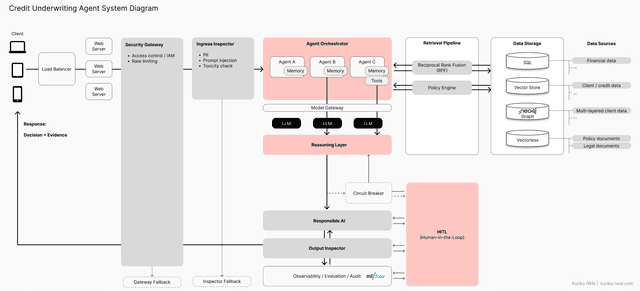
Ship production agents: multi-agent nets, Neo4j GraphRAG related-party credit underwriting + RRF, ColBERT late-interaction retrieval & LangGraph CTR loops.
A practitioner track to shipping agentic systems under latency, cost, and governance constraints. Starts with multi-agent task-graph orchestration, then a regulated credit underwriting agent—Neo4j GraphRAG with hop-decayed related-party risk, RRF hybrid retrieval, multipath self-consistency, AI gateway controls, and fail-closed release gates—then ColBERT late-interaction retrieval and closed-loop LangGraph revenue agents.
Lab Track
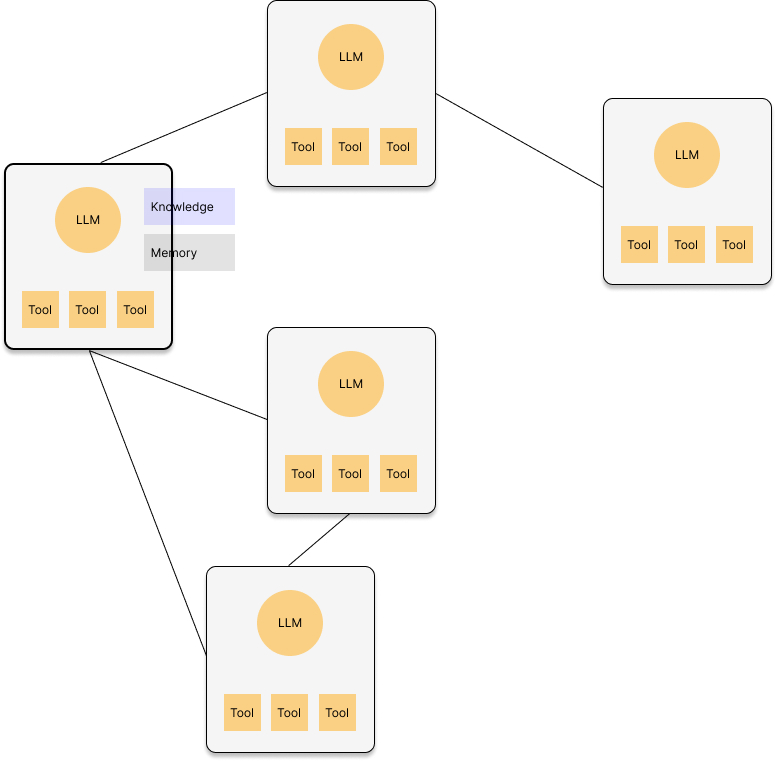
- Orchestrating Autonomous Agent Networks
Automate complex workflows with task-oriented networks, graph-based execution, and self-optimizing agent formations. - Credit Underwriting Agent: GraphRAG, Self-Consistency & Release Gates
Neo4j related-party hops, RRF hybrid retrieval, multi-path voting, AI gateway, and fail-closed promotion on Databricks Apps. - CodeContext: Low-Latency Neural Code Search with ColBERT
Token-level late interaction, Redis semantic cache, and sub-100ms retrieval for real developer queries. - Ad-Creative Agent: Self-Optimizing Creatives with LangGraph
Generator→Critic loop, synthetic CTR rewards, and Bayesian A/B selection before media spend.
Supporting Deep Dives
- How to Design a Production-Ready RAG System (Architecture + Tradeoffs) (2026 Edition)
Master industry-standard RAG architectures and how to architect an optimal RAG pipeline, balancing cost, latency, and precision. - Understanding Vector Databases and Embedding Pipelines
Explore the mechanics of vector databases, text embedding (Dense, Sparse, Hybrid), and similarity metrics like Cosine Similarity with coding examples. - How to Build Reliable RAG: A Deep Dive into 7 Failure Points and Evaluation Frameworks
Master how to evaluate the RAG pipeline and solve common failures with DeepEval, RAGAS, TruLens, and Phoenix.
Interactive Labs
Hands-on systems in series order — multi-agent orchestration → credit scoring agents → retrieval substrate → closed-loop revenue agents.
LAB 01 / 04
Orchestrating Autonomous Agent Networks
A Python framework for building autonomous agent networks with multi-step reasoning. Automated formation, TaskGraph orchestration, and model-agnostic optimization.
LAB 02 / 04
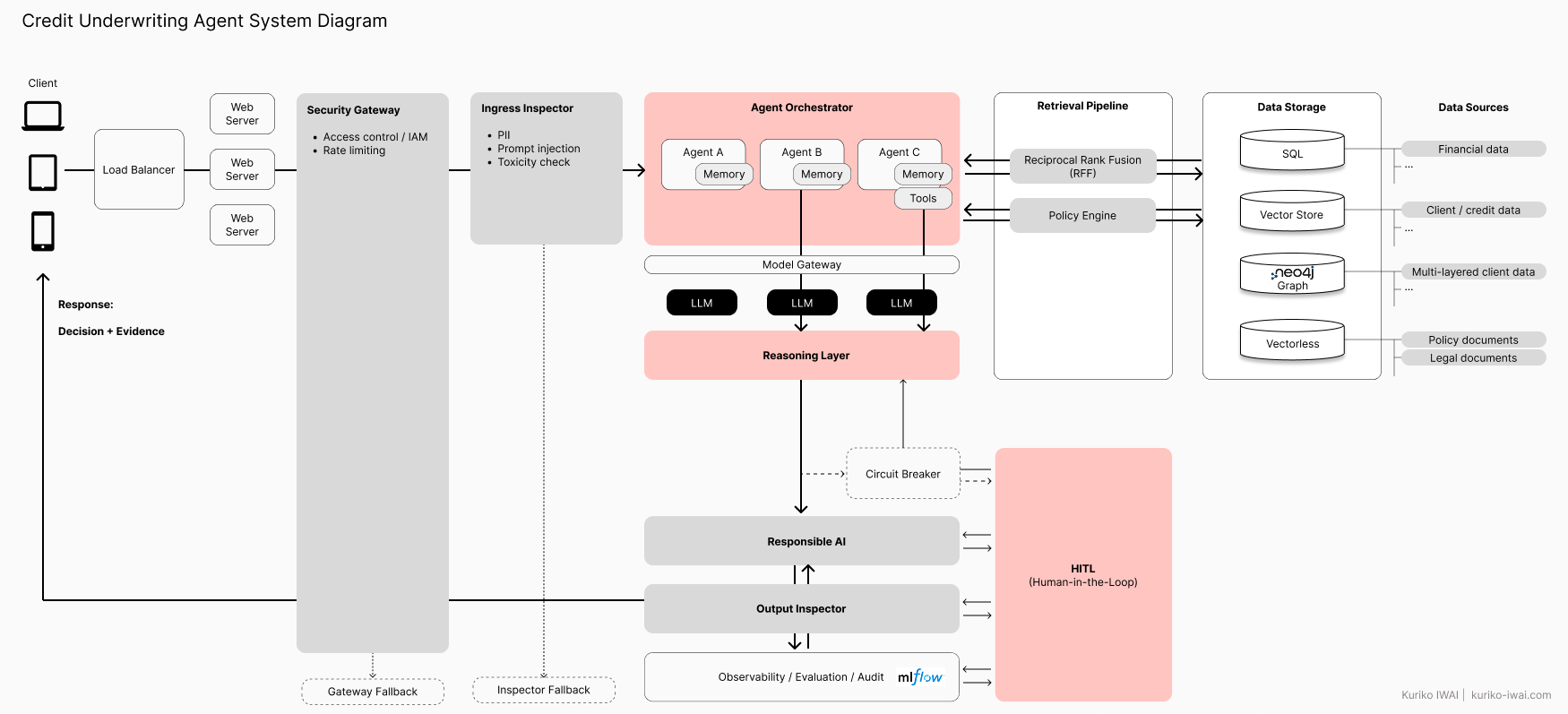
Credit Underwriting Agent: GraphRAG, Self-Consistency & Release Gates
Build a Neo4j GraphRAG credit agent: hop-decayed related-party risk, RRF fusion, multipath voting, AI gateway, and fail-closed release gates on Databricks Apps.
LAB 03 / 04
CodeContext: Low-Latency Neural Code Search with ColBERT
Try ColBERT late-interaction code search live: AST chunking, Redis cache hits, token heatmaps, and sub-100ms latency on a FastAPI retrieval stack.

LAB 04 / 04
Ad-Creative Agent: Self-Optimizing Creatives with LangGraph
Run a live LangGraph Generator→Critic loop with synthetic CTR rewards, prompt refinement, and Bayesian A/B winner selection for ad creatives.
PART 01 / 03
How to Design a Production-Ready RAG System (Architecture + Tradeoffs) (2026 Edition)
Master industry-standard RAG architectures and how to architect an optimal RAG pipeline, balancing cost, latency, and precision.
Vector search alone is no longer enough for enterprise AI.
While a simple NaiveRAG works for basic FAQs, complex reasoning and multi-document synthesis require specialized pipelines.
This guide dissects the six primary RAG architectures—including GraphRAG and Agentic RAG—and provides a rigorous decision framework to help you choose the right stack for your data’s complexity, reliability requirements, and budget.

Kernel Labs | Kuriko Iwai | kuriko-iwai.com
PART 02 / 03
Understanding Vector Databases and Embedding Pipelines
Explore the mechanics of vector databases, text embedding (Dense, Sparse, Hybrid), and similarity metrics like Cosine Similarity with coding examples.
Traditional databases excel at keywords but fail at context.
To bridge the gap between structured storage and neural processing, engineers utilize Vector Databases and Vectorization.
This technical deep-dive explains how unstructured data is transformed into high-dimensional coordinates, explores the mathematical foundations of similarity scoring, and provides practical Python implementations for dense, sparse, and hybrid embedding tactics.

Kernel Labs | Kuriko Iwai | kuriko-iwai.com
PART 03 / 03
How to Build Reliable RAG: A Deep Dive into 7 Failure Points and Evaluation Frameworks
Master how to evaluate the RAG pipeline and solve common failures with DeepEval, RAGAS, TruLens, and Phoenix.
Building a RAG prototype is easy; ensuring it doesn't hallucinate in production is the real engineering challenge.
This article dissects the Seven Failure Points (FPs) of RAG—from missing content to incorrect specificity—and provides a technical roadmap for mitigation using industry-leading evaluation frameworks like DeepEval, RAGAS, and Arize Phoenix.

Kernel Labs | Kuriko Iwai | kuriko-iwai.com
Shipping AI Systems?
I help teams design and deploy scalable ML / RAG / LLM pipelines and MLOps infrastructure.
Or explore:
- Dive deeper 👉 Research Archive
- Learn by building 👉 AI Engineering Masterclass
- Try it live 👉 Playground