Causal Machine Learning: Prediction to Intervention
Build production causal ML: SCM, backdoor adjustment, IPS, and MSM/IPTW for time-varying confounding plus offline treatment-effect estimation for ML engineers.
Standard supervised models fail when policy changes the data-generating process. This series covers structural causal models, the backdoor criterion, feature-flattening traps, Inverse Propensity Scoring (IPS), and Marginal Structural Models (MSM / IPTW) for time-varying confounding—for ML engineers shipping counterfactual evaluation without live A/B tests.
In This Series
- Why Machine Learning Demands Causal Inference
[Series] Causal Machine Learning - 1. Rethinking the Predictive Paradigm - Fixing Selection Bias in Enterprise Data with Inverse Propensity Scoring (IPS)
[Series] Causal Machine Learning - 2. De-Biasing Historical Data Logs (without Expensive A/B Tests) - How to Solve Time-Varying Confounding & Mediator Bias in Longitudinal ML Pipelines
[Series] Causal Machine Learning - 3. De-Biasing Sequential Telemetry and Multi-Period Decisions
PART 01 / 03
Why Machine Learning Demands Causal Inference
[Series] Causal Machine Learning - 1. Rethinking the Predictive Paradigm
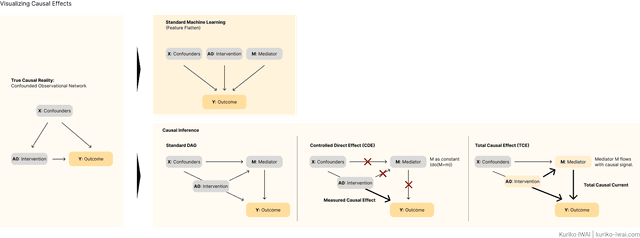
Standard machine learning models excel at empirical risk minimization on static observational data, but fail catastrophically when an operational policy actively alters the data-generating distribution.
This advanced guide exposes the feature flattening trap—where models mistake downstream symptoms for upstream causes—and details how to deploy structurally invariant causal models using Judea Pearls Backdoor Criterion and Off-Policy Evaluation (OPE).

Kernel Labs | Kuriko Iwai | kuriko-iwai.com
PART 02 / 03
Fixing Selection Bias in Enterprise Data with Inverse Propensity Scoring (IPS)
[Series] Causal Machine Learning - 2. De-Biasing Historical Data Logs (without Expensive A/B Tests)
Standard machine learning models fail when observational data is poisoned by selection bias—mistaking baseline confounding for true treatment impact.
Inverse Propensity Scoring (IPS) provides an offline mathematical simulator that transforms biased operational logs into synthetic Randomized Controlled Trials (RCTs).
This guide breaks down the underlying propensity mathematics, positivity constraints, and production Python code to calculate unconfounded Average Treatment Effects (ATE).

Kernel Labs | Kuriko Iwai | kuriko-iwai.com
PART 03 / 03
How to Solve Time-Varying Confounding & Mediator Bias in Longitudinal ML Pipelines
[Series] Causal Machine Learning - 3. De-Biasing Sequential Telemetry and Multi-Period Decisions
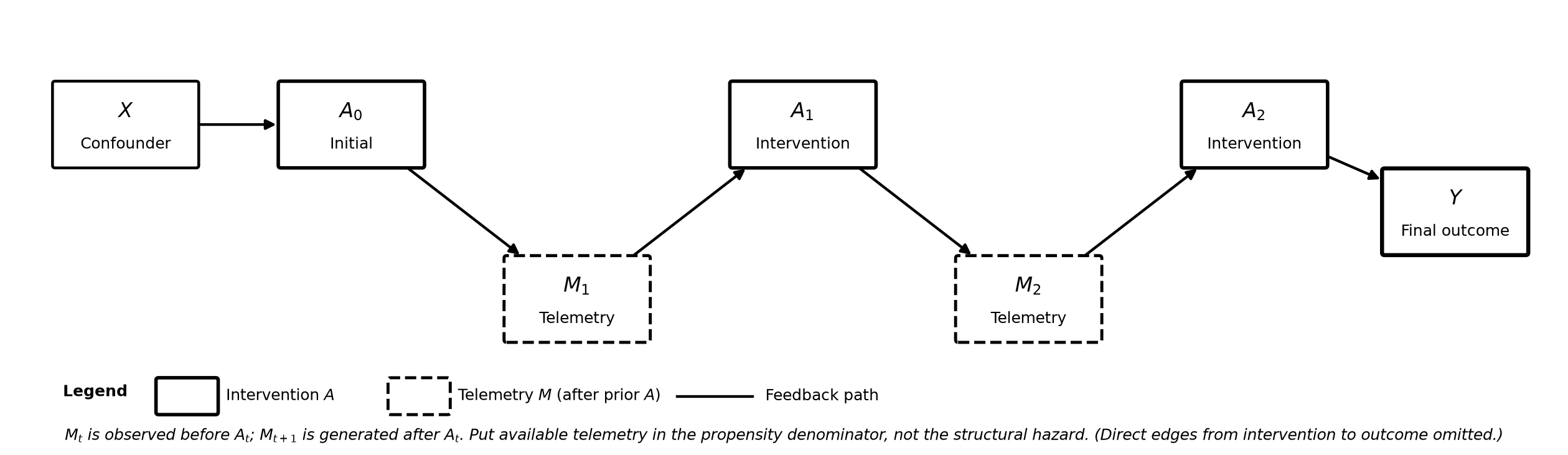
Standard machine learning and static causal models fail in multi-period sequential systems where time-varying telemetry acts simultaneously as a mediator and a confounder.
Naive feature flattening or standard conditioning triggers mediator-blocking bias and collider stratification bias—severely distorting downstream policy evaluation.
This guide explores the mathematics of sequential exchangeability, time-varying inverse propensity weighting (IPTW), and Marginal Structural Models (MSMs) with a production-ready Python implementation.
Kernel Labs | Kuriko Iwai | kuriko-iwai.com
Shipping AI Systems?
I help teams design and deploy scalable ML / RAG / LLM pipelines and MLOps infrastructure.
Or explore:
- Dive deeper 👉 Research Archive
- Learn by building 👉 AI Engineering Masterclass
- Try it live 👉 Playground