Model Fine-Tuning: SFT, LoRA, QLoRA & DPO
Technical LLM fine-tuning series covering SFT/PEFT trade-offs, LoRA mechanics, QLoRA memory optimization, DPO vs RLHF, and SageMaker multi-adapter inference.
A practitioner series on adapting foundation models under real VRAM and latency constraints. Covers SFT vs PEFT, LoRA rank decomposition, QLoRA (NF4, double quantization), DPO vs RLHF, and LoRA multi-adapter inference on SageMaker—for MLEs shipping task-specialized LLMs without a GPU cluster.
In This Series
- The Definitive Guide to LLM Fine-Tuning: Objectivee, Mechanisms, and Hardware
Master LLM fine-tuning with the framework for base model selection, tuning mechanisms, and hardware constraints - Deconstructing LoRA: The Math and Mechanics of Low-Rank Adaptation
Master the math of rank decomposition, hyperparameter tuning, and tips to avoid common pitfalls - A Technical Guide to QLoRA and Memory-Efficient Fine-Tuning
Master how QLoRA enables 70B model tuning on consumer GPUs, leveraging NF4, Double Quantization, and Paged Optimizers. - Aligning LLMs with Direct Preference Optimization (DPO)
Learn the fundamentals and follow a technical walkthrough with Unsloth and Llama. - Building LoRA Multi-Adapter Inference on AWS SageMaker
Decoupling Weights for Scale: A Guide to Dynamic Multi-Adapter Orchestration.
PART 01 / 05
The Definitive Guide to LLM Fine-Tuning: Objectivee, Mechanisms, and Hardware
Master LLM fine-tuning with the framework for base model selection, tuning mechanisms, and hardware constraints
A comprehensive technical deep-dive into the methodologies of fine-tuning Large Language Models (LLMs).
This guide breaks down the transition from foundation models to task-specific experts, covering learning objectives like SFT and DPO, and efficient architectural mechanisms including LoRA, QLoRA, and ReFT.
Ideal for developers looking to optimize model performance while balancing GPU constraints and data requirements.

Kernel Labs | Kuriko IWAI | kuriko-iwai.com
PART 02 / 05
Deconstructing LoRA: The Math and Mechanics of Low-Rank Adaptation
Master the math of rank decomposition, hyperparameter tuning, and tips to avoid common pitfalls
While big tech uses massive clusters for LLM tuning, the real world requires VRAM efficiency.
This deep dive explores Low-Rank Adaptation (LoRA), explaining how it achieves full-tuned performance with 1/10,000th of the expense.
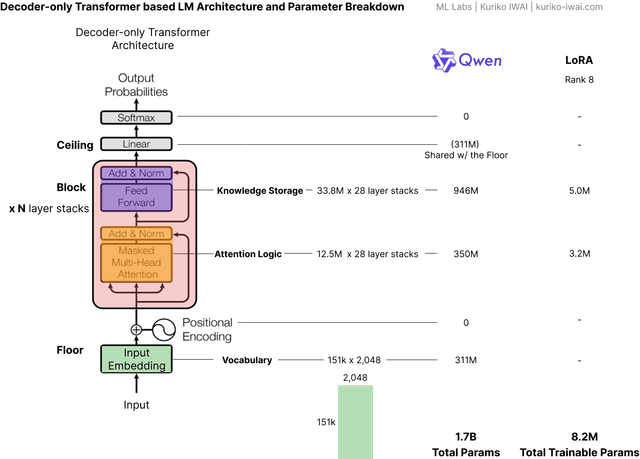
Using Qwen-3-1.7B as a reference, we break down the linear algebra of rank decomposition, provide a guide for tuning hyperparameters (r and alpha), and address critical security pitfalls like data-centric and extraction attacks.

Kernel Labs | Kuriko IWAI | kuriko-iwai.com
PART 03 / 05
A Technical Guide to QLoRA and Memory-Efficient Fine-Tuning
Master how QLoRA enables 70B model tuning on consumer GPUs, leveraging NF4, Double Quantization, and Paged Optimizers.
As Large Language Models scale, the hardware requirements for fine-tuning have become prohibitive for the average developer.
Quantized Low-Rank Adaptation (QLoRA) changes the game by shrinking VRAM requirements by over 95%.
This deep dive explores the core mechanics—NormalFloat 4 (NF4), Double Quantization, and Paged Optimizers—that allow a 70B parameter model to be tuned on a single 48GB GPU without sacrificing 16-bit performance levels.

Kernel Labs | Kuriko IWAI | kuriko-iwai.com
PART 04 / 05
Aligning LLMs with Direct Preference Optimization (DPO)
Learn the fundamentals and follow a technical walkthrough with Unsloth and Llama.
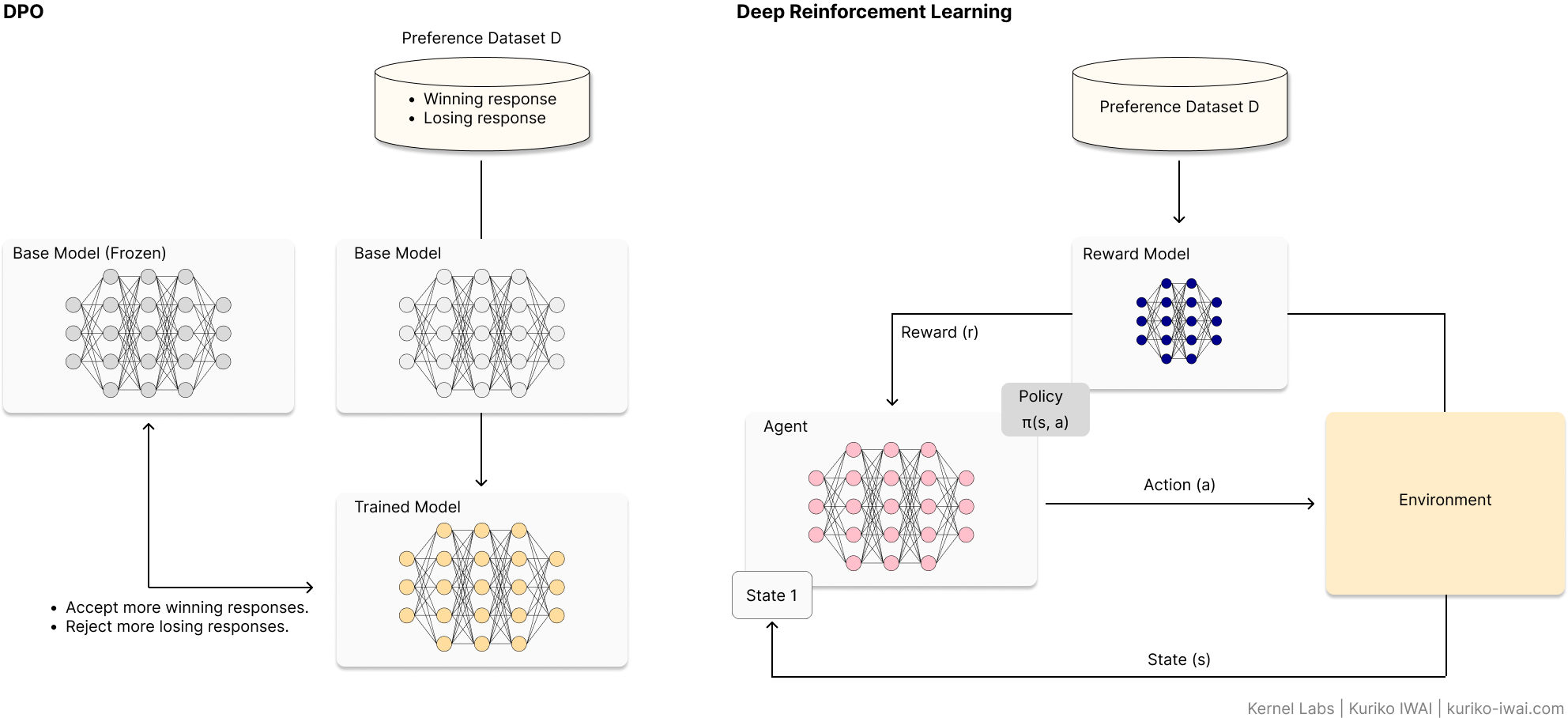
Reinforcement Learning from Human Feedback (RLHF) has long been the gold standard for LLM alignment, but its complexity—requiring separate reward models and unstable PPO loops—is a significant barrier.
Direct Preference Optimization (DPO) simplifies this by treating alignment as a direct classification problem.
This article breaks down the mathematical foundation of DPO, provides a hands-on implementation guide using the Unsloth framework, and explores the strategic trade-offs between DPO and traditional RLHF.
Kernel Labs | Kuriko IWAI | kuriko-iwai.com
PART 05 / 05
Building LoRA Multi-Adapter Inference on AWS SageMaker
Decoupling Weights for Scale: A Guide to Dynamic Multi-Adapter Orchestration.
This technical guide explores the implementation of high-density LoRA (Low-Rank Adaptation) multi-adapter inference.
I demonstrate how to move away from costly dedicated model endpoints toward a unified architecture using Amazon SageMaker Multi-Model Endpoints (MME).
By decoupling the heavy base model weights from lightweight task-specific adapters, developers can achieve a 96% reduction in overhead while maintaining low-latency switching across divergent domains like medical documentation, sales schema enforcement, and linguistic localization.

Kernel Labs | Kuriko IWAI | kuriko-iwai.com
Shipping AI Systems?
I help teams design and deploy scalable ML / RAG / LLM pipelines and MLOps infrastructure.
Or explore:
- Dive deeper 👉 Research Archive
- Learn by building 👉 AI Engineering Masterclass
- Try it live 👉 Playground